The art of reading the sea with stars, winds and markets.
Geography · History · Civics · 10–14
This is a lesson concept. The activities described below are not playable yet.
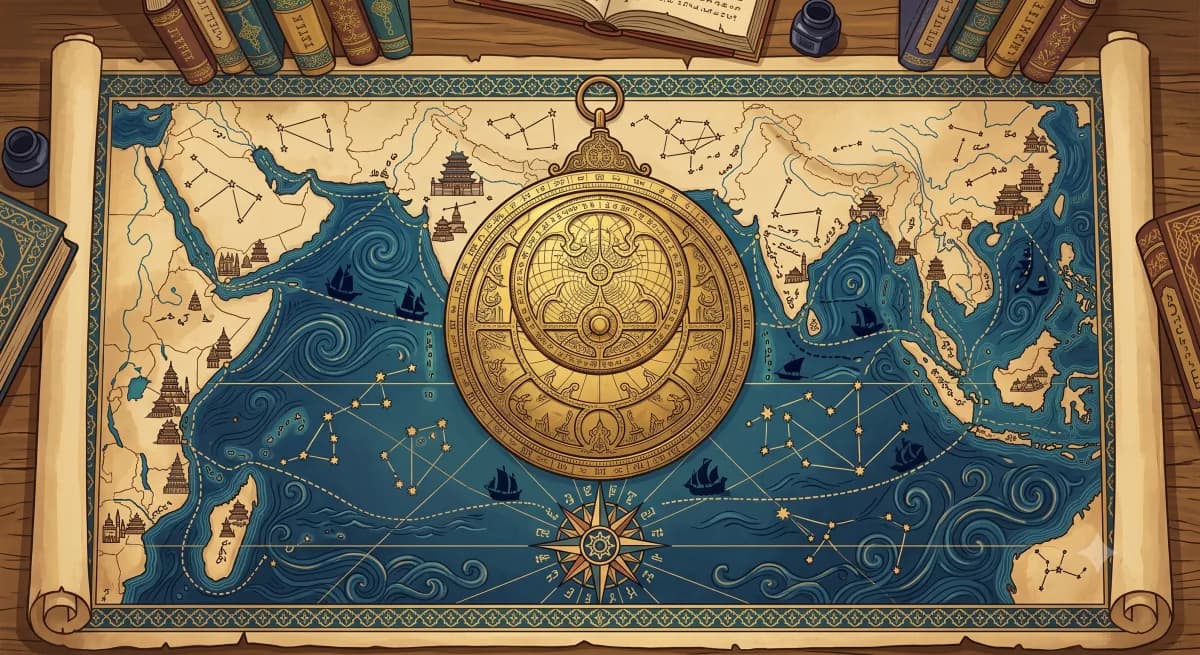
The Indian Ocean, 15th century. Aboard the fleet of admiral Zheng He we complete the map of the “Treasure Routes”, weaving astronomy, geography and economics into a single voyage.
Learning objectives
Astronomical orientation and coordinates
Monsoons, currents and voyage planning
Economic geography: supply, demand, trade
Reading maps and sources that contradict each other
Planned chapters
01
The sky as a compass
Latitude from the stars
With the virtual astrolabe, measure the height of Canopus at midnight: adjust the alidade, read the degrees and estimate the latitude within ±2°.
Hint and discovery
One star is not enough: compare two nights.
The first layer of the map.
02
The breath of the monsoons
The monsoon window
A calendar of winds and currents: choose the departure date that makes the crossing shortest, testing hypotheses and watching the estimated times.
Hint and discovery
Leaving early doesn’t always mean arriving first.
The optimised route.
03
Goods and ports
The smart cargo
Spices, silk, porcelain: maximise the value of your cargo across three ports of call, respecting space and weight limits while watching each port’s demand.
Hint and discovery
Buy at low risk, sell where demand is high.
The goods icons on the map.
04
The nameless port
Triangulating the clues
Astronomical, linguistic and trade clues converge: connect them on the map, filter the candidates and identify the mystery port.
Hint and discovery
A language can betray a water border.
The final annotated map.
In the classroom
Turn the class into a fleet: each team plans its own route on the whiteboard and defends its choices; the smart cargo becomes a collective strategy game.
Curriculum connections
Geography: monsoons and routes
History: Afro-Asian trade
Civics: commercial interdependence
The discovery
The complete nautical chart, with a reflective legend: shared knowledge outgrows the myth of a single “discoverer”.
Ready to play?
Explore the complete Al-Khwarizmi lesson, or try a 3D physics lab.