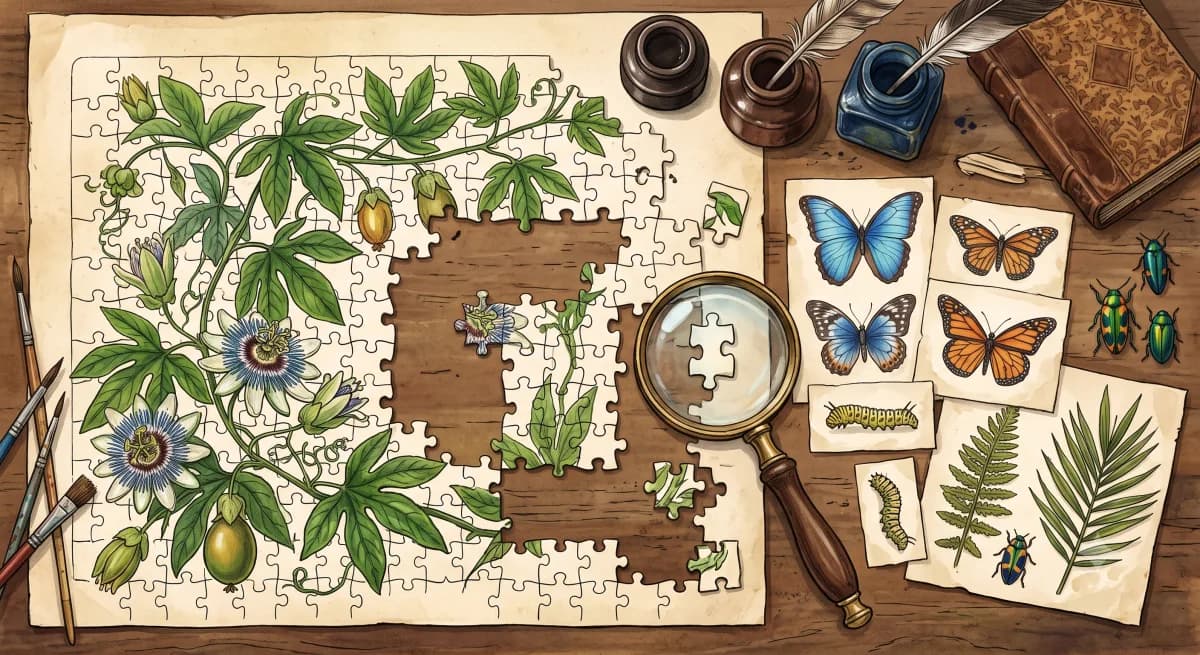
Seeing the small within the big: metamorphosis against the prejudices of the 17th century.
Science · Art · History · 10–14
This is a lesson concept. The activities described below are not playable yet.
Amsterdam and Suriname, late 17th century. We retrace the journey of Maria Sibylla Merian, pioneer of entomology and scientific illustration, and her revolutionary method of observation. The narrative goal is to compose the lost “Atlas of Metamorphoses”; the cognitive goal is to understand life cycles, ecosystems and the relationship between plants and insects.
Learning objectives
Scientific observation and inductive method
Metamorphosis: egg → larva → pupa → adult
Plant–insect relationships and ecological networks
Scientific illustration as a tool for knowledge
Planned chapters
01
The Amsterdam atelier
The cut-up plate
Reassemble a botanical plate cut into 12 irregular pieces: drag, rotate and zoom in to read the micro-details (veins, hairs, ribs). Once the plate is complete, almost invisible larvae emerge on two leaves.
Hint and discovery
Look for continuity in the main veins: they branch like rivers.
A note by Merian on the need to observe “the small within the big”.
02
Routes to Suriname
The flowering window
Six plants, one seasonal timeline: pick the right departure month to find at least four of them in bloom, keeping an eye on the rainy season.
Hint and discovery
Better one long rain than three short ones? Watch what happens to the flowers.
A stretch of map with the key plants of the journey.
03
Metamorphosis in the field
The life timeline
Twelve images of larval stages and pupae from three different species: sort them into three coherent sequences by comparing cuticles and proportions. A surprise: one of the larvae is parasitised.
Hint and discovery
The pupa “breathes” where the cuticle is lighter.
The illustrated card on parasitism.
04
The ecological network
What happens if…
A food web with eight nodes (plant → herbivore → predator → parasitoid): remove one node at a time and watch the effects, until you identify the two key nodes of the balance.
Hint and discovery
A gap at the top can make the bottom explode.
The “Master Plate” that brings all discoveries together, with a final letter from Merian.
In the classroom
Project the cut-up plate on the interactive whiteboard and reassemble it with the class split into teams; the food web of chapter 4 works beautifully as a guided discussion: “if we remove this node, what happens?”.
Curriculum connections
Science: metamorphosis and food chains
Art: scientific illustration
History: travel and science in the 17th century
The discovery
The complete illustrated atlas and an imaginary letter from Merian explaining her method. Hints never give solutions, only guiding questions: knowing and understanding are the reward.
Ready to play?
Explore the complete Al-Khwarizmi lesson, or try a 3D physics lab.