01
Reading diffraction
Photo 51 in miniature
Simplified diffraction patterns: measure angles and distances to recognise the symmetries that speak of a helix.
Hint and discovery
The cross speaks of helices.
The technical note on diffraction.
LESSON PREVIEW · IN DEVELOPMENT
Truth in images: rigour, precision, and the credit that is due.
Science · Ethics · 12–14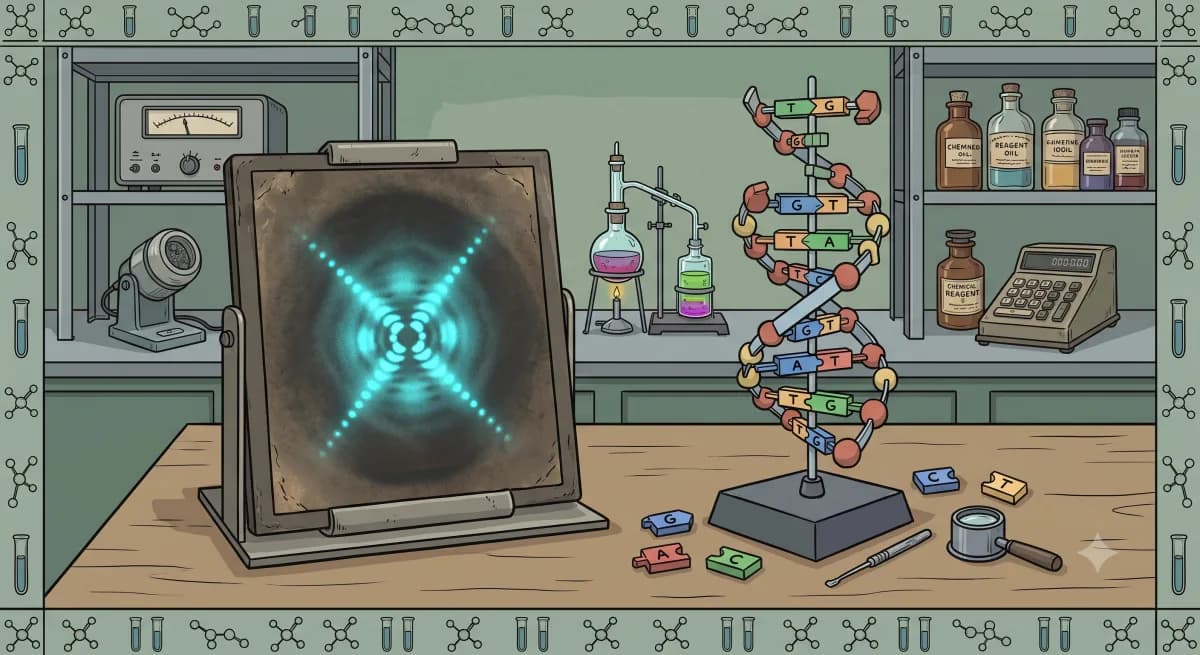
This is a lesson concept. The activities described below are not playable yet.
London, the 1950s. In Rosalind Franklin’s laboratory we learn to read the experimental data that led to the double helix of DNA: hypotheses to test, evidence to interpret and models to make speak.
01
Simplified diffraction patterns: measure angles and distances to recognise the symmetries that speak of a helix.
The cross speaks of helices.
The technical note on diffraction.
02
Use the sliders to find plausible values for the helix pitch and the distance between bases: coherence checks itself.
Too tight? Too wide?
The first pieces of the model.
03
Single strand, triple helix, double helix: overlay the predicted patterns on the real data and discard whatever doesn’t hold.
Let the data speak, not the desire.
The model assembly bench.
04
Four objections to satisfy with the right evidence: cite measurements and patterns to defend the model in front of colleagues.
Cite measurement and pattern.
The final reconstruction and an ethical note.
The model-versus-data comparison makes an excellent science debate: teams defending different hypotheses in front of the same evidence projected on the whiteboard.
The complete 3D model and the story of “Photo 51”: a reflection on who gets the credit in science.
Explore the complete Al-Khwarizmi lesson, or try a 3D physics lab.
Play Al-Khwarizmi →